When the Interview Ends: Reading Public Images with Care
Reading athlete public images with care helps separate what a press appearance shows from guesses about private feelings, relationships and life beyond sport.
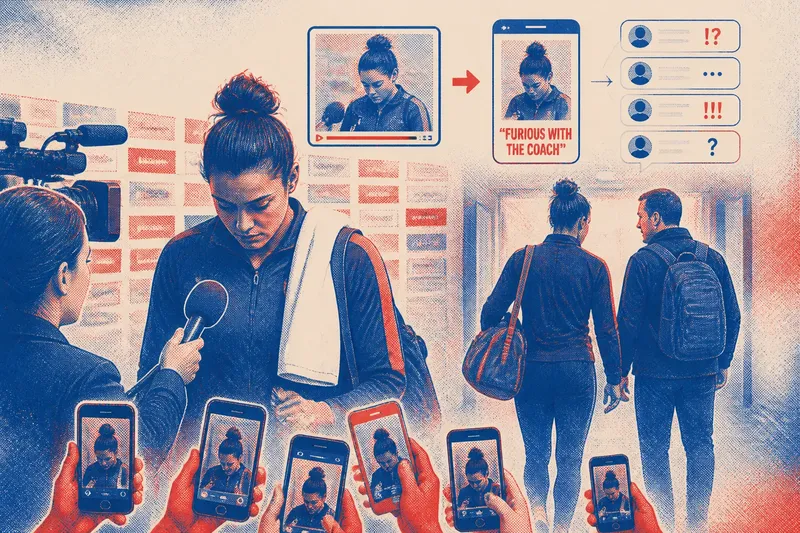
An athlete’s public image is evidence of an appearance, not a reliable transcript of private life. Reading athlete public images with care starts with a modest distinction: a camera records what happened in view, while captions and commentary often supply motives the image cannot establish.
Consider a clearly hypothetical scene. After a difficult match, a player gives a short interview, looks down while answering a question, then leaves with a staff member. A clip circulates with the caption “furious with the coach”, and viewers begin treating the two visible gestures as a confession. The scene gives us something to examine, but it does not settle what the player felt, what the relationship is like, or what happened after the camera stopped.
This walk-through follows that invented scene from first impression to a more careful reading. The point is not to drain public moments of meaning. It is to keep observation, interpretation and private fact from being folded into one confident story.
The visible scene
Begin with what a person could describe without guessing. In this case: the interview was brief; the player looked down during an answer; a staff member walked alongside them afterwards. If the recording includes the words, those can be noted too. If it does not, a viewer should not supply them from a headline.
That inventory may feel almost comically plain. Plainness is useful. “Looked down” describes a movement. “Looked ashamed” assigns an emotion. “Left with a staff member” reports company. “Was comforted by a close friend” adds a relationship and a purpose that the image does not identify.
Even apparently simple details can be incomplete. A cropped video may start after a question, remove an answer or end before a conversation continues. A still photograph freezes one instant from a longer exchange. The first task is to find the full interview or the complete sequence, if it is available, and check whether the circulating version has omitted relevant context.
In the invented scene, the full recording confirms the player’s brief answers and downward glance. It also shows that the interviewer asked several questions in quick succession and that the player spoke at greater length earlier. This context changes the picture’s texture, but it still does not disclose the player’s private feelings.
What the image suggests
Public images invite interpretation because people naturally connect visible actions to familiar meanings. A lowered gaze may be read as sadness, irritation, concentration, fatigue or simple attention to the floor. A clipped reply may sound hostile to one viewer and measured to another. The interpretation can be understandable without being established.
Separate a plausible reading from a supported claim. “The exchange appears tense” is an interpretation tied to observable features, such as pauses, tone or the wording of the question. “The player is angry at the coach” is a claim about a particular private state and its target. It needs evidence beyond a facial expression and a departing walk.
Captions often make this leap quietly. They turn a question into a premise: “Why the player looked devastated” assumes devastation; “The strained relationship behind the silence” assumes both strain and a relationship problem. Before sharing a caption, ask what it states as fact and what it asks the reader to infer.
In the hypothetical case, viewers can reasonably say the player gave a short answer in a public interview. They may say the moment seemed uncomfortable, provided they make clear that this is their reading. They cannot establish anger at the coach from the glance and exit alone. The coach is not even visible in the described scene.
Where context stops
Context can correct a misleading impression. It cannot convert an appearance into unrestricted access to someone’s life. Knowing the score, the question asked or the order of events may explain why a moment looked a certain way. It does not automatically reveal what the athlete felt, what they discussed privately or how a relationship works away from the event.
This boundary matters especially when a public figure is expected to perform openness. An interview is a work setting with a purpose and an audience. The athlete may choose what to answer, keep a response brief, or decline to offer personal detail. None of those choices entitles viewers to treat silence as a hidden statement.
Nor does a warm exchange establish a close private bond. A smile with a teammate, a hand on someone’s shoulder or a shared departure can show visible friendliness. It cannot, on its own, establish that two people are confidants or that they have resolved a disagreement. Public warmth is real as an observed interaction; the story built around it may not be.
In the invented scene, the staff member’s presence is all the recording establishes about their connection. They could be a coach, a media worker, a colleague or someone else. Even if their role were known, the scene would not explain why they walked together. The useful limit is simple: identify the person only when the source does, and avoid assigning a private purpose to the walk.
Following the clip
Now imagine the clip is shared by a fan account and then repeated by several commentary pages. Repetition can make a claim feel corroborated, although each post may trace back to the same short recording. The invented reader checks the original broadcaster’s full interview, compares the caption with the spoken exchange and finds no independent source for the claim about anger.
The reader can then make a restrained account: the player answered briefly after the match, and the edited clip has encouraged speculation about the coach. That account distinguishes the public event from the claim attached to it. It also avoids treating the absence of a correction as confirmation. Athletes are not obliged to answer every interpretation of a clip.
When deciding whether to share, ask whether the post adds information or merely intensifies a guess. A headline that turns “looked down” into “heartbroken” has not necessarily added evidence. If the image concerns a sensitive relationship, health matter or family situation, the cost of a confident but unsupported inference is greater than the small pleasure of being first with a theory.
What is not worth the effort is decoding every blink, pause or angle as if the image were a puzzle with a private answer. Slow-motion analysis of a face can produce elaborate readings without making them more secure. The more elaborate the theory becomes, the more useful it is to return to the recording and ask what is plainly there.
Careful readings?
Does a facial expression reveal an athlete’s feelings?
It can contribute to an impression, but it does not identify a feeling with certainty. Describe the expression or qualify the interpretation rather than presenting an inferred emotion as fact.
Can a short answer prove a player is unhappy?
No. Brevity may have many causes, and a clip may omit the surrounding exchange. The answer itself can be quoted or described, while the reason for its length remains unknown unless the athlete explains it.
What should I check before sharing a clip?
Look for the original source, the full exchange and any text that has been added around the footage. Notice whether the caption introduces a motive or relationship claim that the recording does not show.
Is it intrusive to discuss a public appearance?
Discussing what happened in public is different from claiming access to private feelings or relationships. Keep commentary tied to the event and leave personal details alone unless the person has chosen to share them.
A better public record
Return to the hypothetical scene at the point where the reader is ready to describe it. A careful account says that the player gave a brief interview after a difficult match, looked down during one answer and walked away beside a staff member. It notes that a circulating caption attributes anger to the player, but the recording does not establish that explanation.
That wording is not evasive. It preserves the event and identifies the disputed interpretation. If the player later chooses to discuss the moment, that statement can be added as their account, not retroactively treated as something the original image already proved. If no explanation follows, the uncertainty remains ordinary uncertainty, not a mystery viewers are entitled to solve.
For anyone writing, posting or talking about sport, the practical habit is to keep three categories distinct: what the source shows, what the viewer thinks it may mean, and what remains private or unknown. Reading athlete public images with care does not forbid interpretation. It makes the boundary visible, so an athlete’s public appearance can be discussed without turning a glance into a biography.